



Asia Pacific
Register for free with StrategicRISK
Unlock full access to award-winning journalism tailored for senior risk professionals. StrategicRISK goes beyond the headlines, offering in-depth analysis, exclusive case studies, and global insights designed to help you anticipate threats, shape strategy, and lead with confidence.
If you are already registered, please sign-in for access.
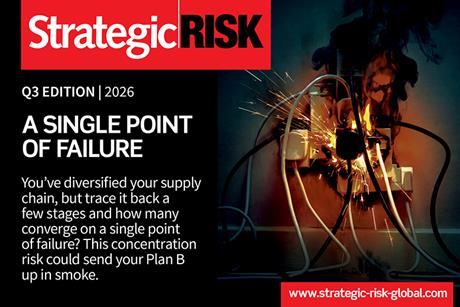
SR Q3 2026: When risks collide
The threats facing businesses may be familiar, but the way they are concentrating and cascading feels different. As one problem becomes five, risk managers need to understand where the weak points lie, and make sure their work changes what happens next.

Regulation watch: Frontier AI as a cyber weapon
Albert Yuen of Eversheds Sutherland examines regulatory developments in Asia and the UK/EU in response to the cyber risks posed by frontier AI models.

Supply chain disruption pushes risk managers to demand more from marine insurers
Corporate risk managers want marine insurers to move beyond traditional cargo cover and play a broader role in building supply chain resilience as geopolitical disruption, sanctions, cyber threats and longer transit routes intensify.

Rare earth dispute exposes compliance collision in global supply chains
Chinese countermeasures against a major supply-chain due diligence body are beginning to collide with rare-earth trade, creating new problems for businesses trying to meet different regulatory requirements across global supply chains.

The convective storm surge and what risk managers can still control
Severe convective storm losses were below trend in the first half of 2026, but elevated storm activity shows why businesses cannot afford to ease off on resilience.
Low water is becoming a chronic supply chain risk for organisations reliant on inland waterways
Inland waterways are central to lower-carbon freight strategies, but recurring drought is exposing the risks of supply chains built around historically reliable river systems.

Climate risk exposes adaptation gaps in pharma supply chains
Almost nine in ten pharmaceutical companies expect climate-related disruption to their supply chains to increase, but new research suggests practical adaptation remains limited and supplier visibility is still a significant barrier.

Lithium chokepoints put global supply chains at risk
WTW research shows how shocks across South America’s Lithium Triangle could spread through contracts, logistics networks and balance sheets without causing direct physical damage.

Regional spotlight: India’s risk management evolution struggles to keep pace with growth
India is a place of contradictions – restless, industrious, but lacking the resilience to fully handle its status as the world’s fastest-growing economy. Risk management is evolving, but gaps remain. APAC correspondent Trevor Treharne spent a month in the country to learn more.

Lower catastrophe losses give risk managers a window to strengthen protection
First-half catastrophe losses remained manageable for insurers, but regional extremes, earthquakes, heat and shifting weather patterns show why organisations should use improving market conditions to address gaps in their resilience.

What lies beneath the calm waters of Asia’s E&P lines
The executive and professional lines market is offering its most favourable pricing in years – but beneath these softening conditions, global tension, rising insolvencies and digital enforcement are ever-harder to navigate. Smart buyers will use the moment to secure better cover with partners built to last, writes BHSI’s Scotland Walsh-Riddle.

Sector spotlight: Food firms strengthen continuity as confidence falls
Food, beverage and agriculture businesses are formalising continuity plans, but confidence has fallen as risks spread across operations and gaps in resources and insurance protection persist.
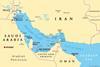
Strait of Hormuz disruption exposes risks far beyond oil
Renewed disruption in the Strait of Hormuz is showing how quickly a shipping crisis can spread through global energy, trade and food systems

Case study: What Ueno Park reveals about climate stress in Asian cities
HDI Risk Consulting’s assessment of Tokyo’s Ueno Park shows how extreme heat and heavy rainfall can expose wider risks to tourism, infrastructure, public health and business continuity

Regional spotlight: Philippine firms face an archipelago of economic, climate and cyber risks
Philippine corporate risk in 2026 is defined by clusters of economic, regulatory, climate and cyber threats that intersect. As shocks compound and oversight intensifies, risk management is shifting from compliance to a strategic system for resilience.

Regulation watch: The rise of agentic AI across Asia and what it means for businesses
Albert Yuen of Eversheds Sutherland examines emerging regulatory guidance on agentic AI and what it means for businesses deploying and developing autonomous AI systems.

Airmic 2026: Gulf deal buys time, not certainty, risk managers warned
A conditional agreement to reopen the Strait of Hormuz may ease pressure on energy markets, but companies with Gulf exposure should not assume regional stability has returned.

Risk tool spotlight: getting to grips with risk appetite
Appetite defines the level of risk organisations will venture into, but only if it sticks. Closing the gap between intent and reality means linking appetite to strategy, controls, investment and measurable indicators.
SR Q2 2026: Reflections at 40,000 feet
Recent conferences have left me more convinced than ever that platforming risk voices is our raison d’être. Innovators are telling me that it’s all about improving decision-making, and this issue is dedicated to helping you do that.
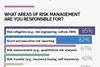
SR:500 survey results: Risk managers push for earlier influence as threats accelerate
The SR:500 Emerging Risks survey reveals a landscape dominated by accelerating and interconnected threats. Against this backdrop, risk management must be embedded earlier in decision making to strengthen resilience.


- Forgotten Password
- Contributors
- Feedback
- Media Pack
- © StrategicRISK 2026
Part of the Insurance and Risk group of
Newsquest Specialist Media
Newsquest Specialist Media



Published by Newsquest Media Group Limited,
registered in England & Wales with number 01676637
at The Echo Building, 18 Albert Road, Bournemouth,
England, BH1 1BZ - a USA Today company
registered in England & Wales with number 01676637
at The Echo Building, 18 Albert Road, Bournemouth,
England, BH1 1BZ - a USA Today company
Site powered by Webvision Cloud